A waste baler is a machine that can significantly impact space management, handling costs, and collection frequency. For this to happen, however, it must be chosen based on the company's actual throughput. A model that's too small risks quickly becoming inadequate, while an oversized machine can become an inefficient investment.
Knowing the total amount of waste produced isn't enough: you need to consider factors such as the type of materials, disposal frequency, available space, loading method, bale weight, and even internal organization. Mistakes made during this phase tend to emerge only after installation, when intervention becomes more complex.
Waste press chosen only based on the kilograms produced
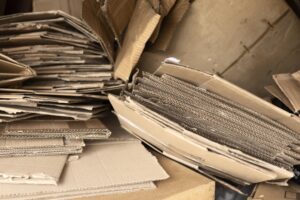
One of the most common mistakes is sizing a baler based solely on the weight of waste produced each day or week. It's important to remember, however, that different materials may have the same weight but occupy completely different volumes: 100 kg of cardboard doesn't behave like 100 kg of plastic film or PET bottles.
The initial density of the material directly affects the number of cycles required, the loading frequency and the ability of the press to operate without slowing down normal business operations.
Waste press undersized for peak workloads
Another mistake is choosing a waste baler based on average production, ignoring peak periods. Many companies generate uneven waste throughout the year. For example, supermarkets and distribution centers may experience peaks related to promotional periods, holidays, or increased deliveries. An e-commerce warehouse may find itself handling much higher-than-average quantities of cardboard during certain months. And a manufacturing company may have weeks when the materials to be baled increase rapidly, perhaps due to unpredictable contextual factors.
If the machine is sized only for standard operations, it can become the process's weak point during peak periods. Operators must wait for cycles to complete, material builds up, and the need for temporary handling increases.
Oversized waste press: bigger doesn't always mean better
At the same time, choosing a baler that's too large can also be a mistake. A machine with a capacity greater than actual needs takes up more space, requires a higher initial investment, and may have operating costs that aren't justified by the volumes handled. For a small business producing limited quantities of cardboard, for example, a compact vertical baler may be more rational than an automatic solution designed for continuous flows.
The machine must have sufficient headroom to handle variations and future growth, but it shouldn't be chosen simply by choosing the most powerful model available. From this perspective, the cost per bale produced and the machine's actual utilization rate are more useful parameters than compaction force alone.
Waste balers and material types: the mistake of considering all waste the same
Not all waste balers are suitable for the same materials. This is one of the most easily overlooked aspects: cardboard, paper, plastic film, PET, cans, and foam materials have very different physical characteristics. For example, their compressive strength, their tendency to expand after the cycle, their ease of loading, and even the way they must be tied vary.
A machine that's effective for cardboard isn't the solution for polystyrene. Likewise, a baler designed for dry materials isn't necessarily the solution for handling containers that are still full or contaminated with liquids.
The loading mouth: a detail that can slow everything down
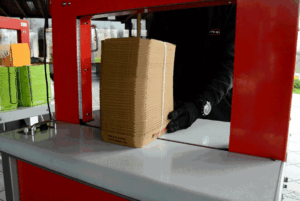
The size of a waste baler's inlet opening is often less considered than the compression force, but it can have a huge operational impact. If bulky boxes, packages, or scraps must be folded, cut, or shrunk manually before being fed, some of the compaction benefits are lost, operators spend more time, and the machine can become a new bottleneck.
A loading chute suited to the material allows the press to be fed with less preparation. This is particularly important in logistics centers and large-scale retail outlets, where boxes and packages arrive in a wide variety of formats. Furthermore, for very high volumes, it may be necessary to consider feeding systems using conveyor belts, tilters, or trolleys to further reduce manual labor.
Waste baler and bale weight: be careful when handling
Sizing a waste baler also means considering what happens after compaction.
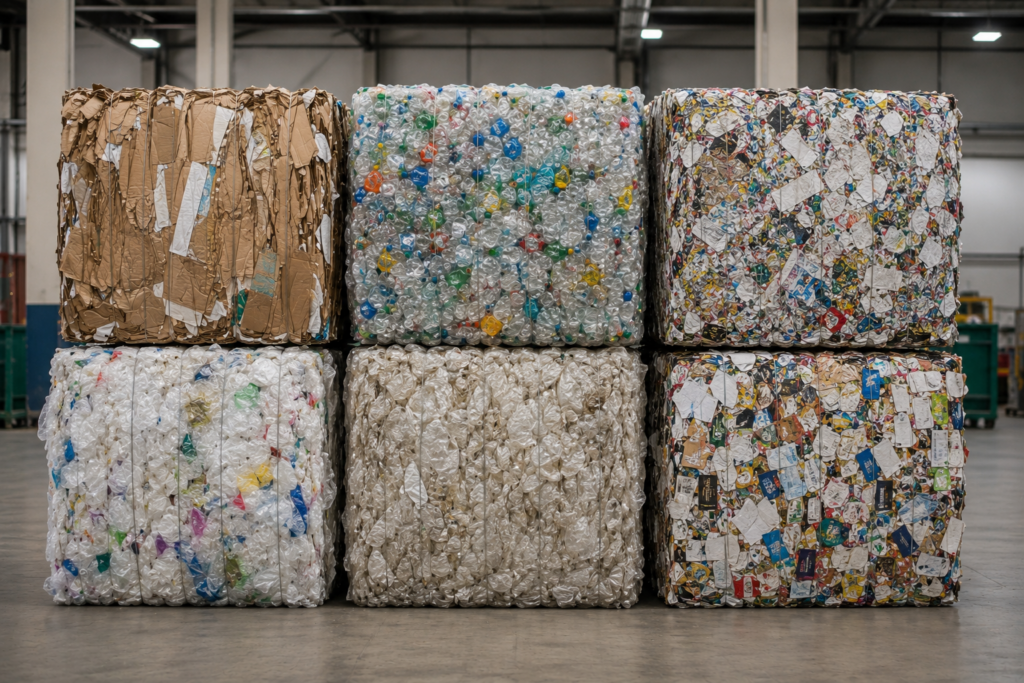
A very heavy bale can be advantageous because it concentrates more material and reduces the number of units to be stored and transported. There's a catch: the company must have the necessary equipment to handle it safely.
If a baler produces bales weighing several hundred kilograms, it will typically be necessary to use forklifts, suitable pallet trucks, or other handling equipment. Installing a highly productive machine without considering this step can create operational difficulties right downstream. The space required for bale ejection and accumulation must also be verified before installation. The machine doesn't work in isolation: it must fit into the actual warehouse layout.
Don't just consider the size of the machine
Another factor that's often overlooked when evaluating a waste baler is the operating space, which is often larger than the nominal footprint. Space must be provided for loading, opening doors, replacing binding materials, performing maintenance, and ejecting the bale. For machines powered by containers, belts, or trolleys, the space required for these operations must also be included.
Too narrow a location can increase work times and make technical interventions more difficult (and less safe). Conversely, positioning the baler close to where the waste is produced can significantly reduce internal handling.
Effe3Ti waste baler: why sizing must start from the process
The Effe3Ti catalog includes waste balers with very different characteristics, precisely because there isn't a single machine suited to every application. A vertical solution may be suitable for companies that need to handle medium to low volumes while maintaining compact dimensions. More structured models can handle larger flows, while automatic balers such as BaleTainer They are designed for contexts in which business continuity becomes a priority.
Then there are even more specific applications, in which the problem is not only the volume. For example, Styropress is dedicated to expanded polystyrene, while systems like Liquidrainer They intervene in the management of containers with residual liquids before the subsequent recovery phases.
Choose well today to work better tomorrow
There are two main risks associated with an inadequate waste baler: either it's undersized for the workload, or the investment was higher than necessary. The baler shouldn't be considered an independent component of the rest of the warehouse: in reality, its performance depends on everything that happens before and after the compaction cycle.
A properly sized machine reduces buildup, limits handling, improves space utilization, and makes waste management more predictable. And it's precisely this ability to integrate into the company's actual processes, more than just its declared capacity, that determines the effectiveness of the investment over time.