Cardboard balers are a highly effective, yet often underestimated, lever for companies seeking to reduce their environmental impact in a concrete, measurable, and immediately operational way.
While cardboard was once considered solely for recycling, today the issue is broader: packaging management is an integral part of ESG strategies and sustainability plans, as well as all the logistical choices that drive efficiency and competitiveness, but also positively impact a company's reputation.
In recent years, the rapid spread of e-commerce and the resulting increase in incoming packaging and the need to optimize space have transformed cardboard from a simple waste product to a truly critical issue in corporate organization. In many departments, this creates backlogs, slows down flows, and increases disposal costs.
It is in this context, then, that vertical and automatic cardboard balers become strategic tools: they free up space, improve internal sustainability and reduce resource consumption.
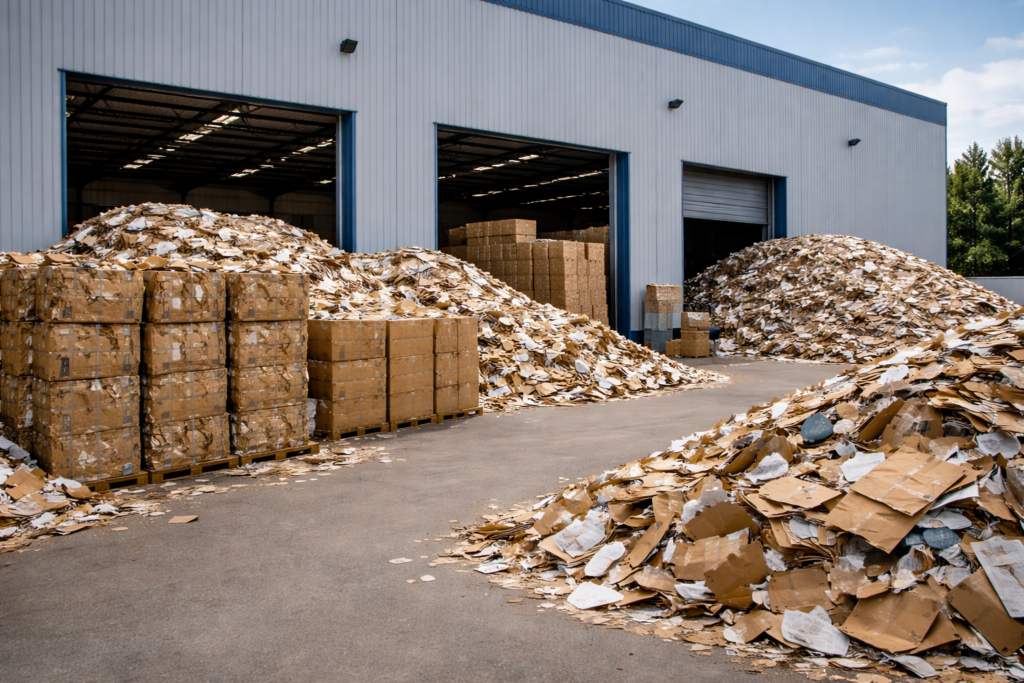
Cardboard balers and sustainability: why they are a strategic choice
Integrate the cardboard presses, and the packaging presses In general, within waste management, it allows for direct intervention on three dimensions: environmental, economic, and organizational. From a sustainability perspective, reducing waste volumes requires fewer trips for disposal providers, lower emissions, less vehicle use, and more efficient waste sorting.
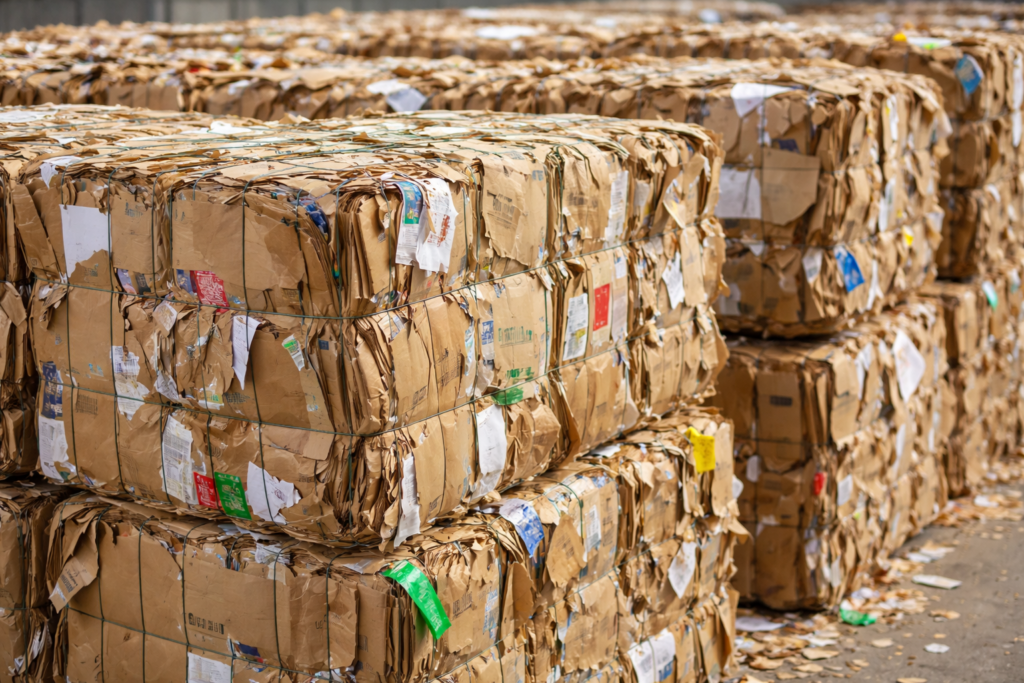
Compaction transforms dozens of bulky boxes into neat bales that are easy to store and ready for recycling.
All this improves the material recovery rate and allows the company to align with environmental regulations and ESG standards. Furthermore, having standardized bales facilitates traceability and allows for the economic valorization of cardboard, which can become a resource rather than a cost.
How cardboard balers help reduce costs
Sustainability isn't just an ethical choice, it's also an economic driver. Reducing cardboard volumes means:
- reduce the frequency of emptying;
- use less warehouse space;
- and reduce the personnel dedicated to handling waste.
In many logistics or large-scale retail trade companies, where the flow of boxes is constant, cardboard balers dramatically reduce handling times. Likewise, smaller businesses can better organize their space, avoiding crowded aisles or materials that slow down operations. Less chaos means greater safety, fewer accidents, and greater operational efficiency.
The result is twofold: the environmental impact is reduced and tangible economic savings are achieved.
Cardboard balers: which models to choose to maximize their positive impact?
To truly transform cardboard into a circular and efficient process, choosing the right baler is essential. Effe3Ti offers solutions that meet both small-scale needs and large industrial volumes. Here are some concrete examples.
BP53: the vertical baler for large volumes of cardboard
There BP53 It is a vertical chamber baler designed for companies that handle large quantities of cardboard on a continuous basis.
With a baling force of 580 kN, it produces extremely compact and dense bales (weighing 40 kg and measuring 1200 x 1100 x 800 mm), ideal for optimizing storage and minimizing transportation to recycling plants. It can also handle film, cans, foam rubber, electronic waste, and PET bottles.
Thanks to the generously sized loading mouth, equipped with a sliding door, and the robust structure, the BP53 is particularly suitable for industrial, logistics, and distribution center environments. The bales produced are easy to handle and standardized.
MK1100: the multi-chamber baler for differentiated cardboard management
There MK1100 It's a vertical multi-chamber baler that addresses an increasingly common need: separating and compacting multiple types of material in the same space. With a pressing force of 200 kN, it allows you to manage cardboard neatly and efficiently, placing it alongside other waste streams without mixing. It can also handle film, PET bottles, and cans. It creates 250 kg bales measuring 1100 x 700 x 800 mm.
This cardboard baler is ideal for businesses, commercial establishments, or logistics companies that produce cardboard along with other materials and want to maintain strict waste separation. The multi-chamber configuration optimizes space, reduces handling times, and improves internal organization.
GigaBaler: the high-density baler for large volumes of paper and cardboard
Then there is the GigaBaler, a baler designed for industrial environments where paper and cardboard volumes are high and operational continuity is therefore a must. With a compaction force of 60 tons, it is designed to transform large quantities of material into high-density bales, standardized to the size of a euro pallet and with a typical weight between 500 and 550 kg.
The GigaBaler features a heavy-duty integrated shredding rotor, allowing it to process cardboard, paper, and TetraPak cartons continuously and without pretreatment. The material is forced into the rotor by a hydraulic oscillating plate located at the base of the feeding chamber, allowing the machine to be fed at any time without interrupting the baling cycle.
It can be loaded manually or integrated into more structured systems, using box, cage, or pallet tippers, forklifts, shovels, or grippers, or even automatic feeding via a conveyor belt. The resulting bales, with dimensions ranging approximately from 600 to 1600 x 1100 x 750 mm, are tied with wire, ensuring stability and ease of handling.
Small gestures, big results
Cardboard balers, therefore, are tools that allow companies to rethink waste management in a modern and sustainable way. Whether a small business or a large logistics hub, investing in a baler means creating order, reducing waste, cutting costs, and directly contributing to environmental sustainability.
In a world that demands efficiency and responsibility, the path is clear: transforming waste into resources is the smartest choice a company can make.