Pallet wrappers are often the last link in the production chain, but also one of the most delicate. This is where a load is secured before leaving the warehouse; and this is where a poor choice can result in instability, increased risk of damage during transport, or even operational delays.
However, not all wrapping machines work the same way. Behind a seemingly simple function lie two different technologies, each designed to meet specific needs.
The distinction between a turntable or rotating arm pallet wrapper is not only technical, but also operational:
- change the way the pallet is treated;
- the machine's ability to adapt to the most complex loads.
Therefore, understanding the differences between these two solutions means making more informed choices, avoiding compromises that, over time, could impact the efficiency of the entire end-of-line process.
Rotating table pallet wrappers: when simplicity is an advantage
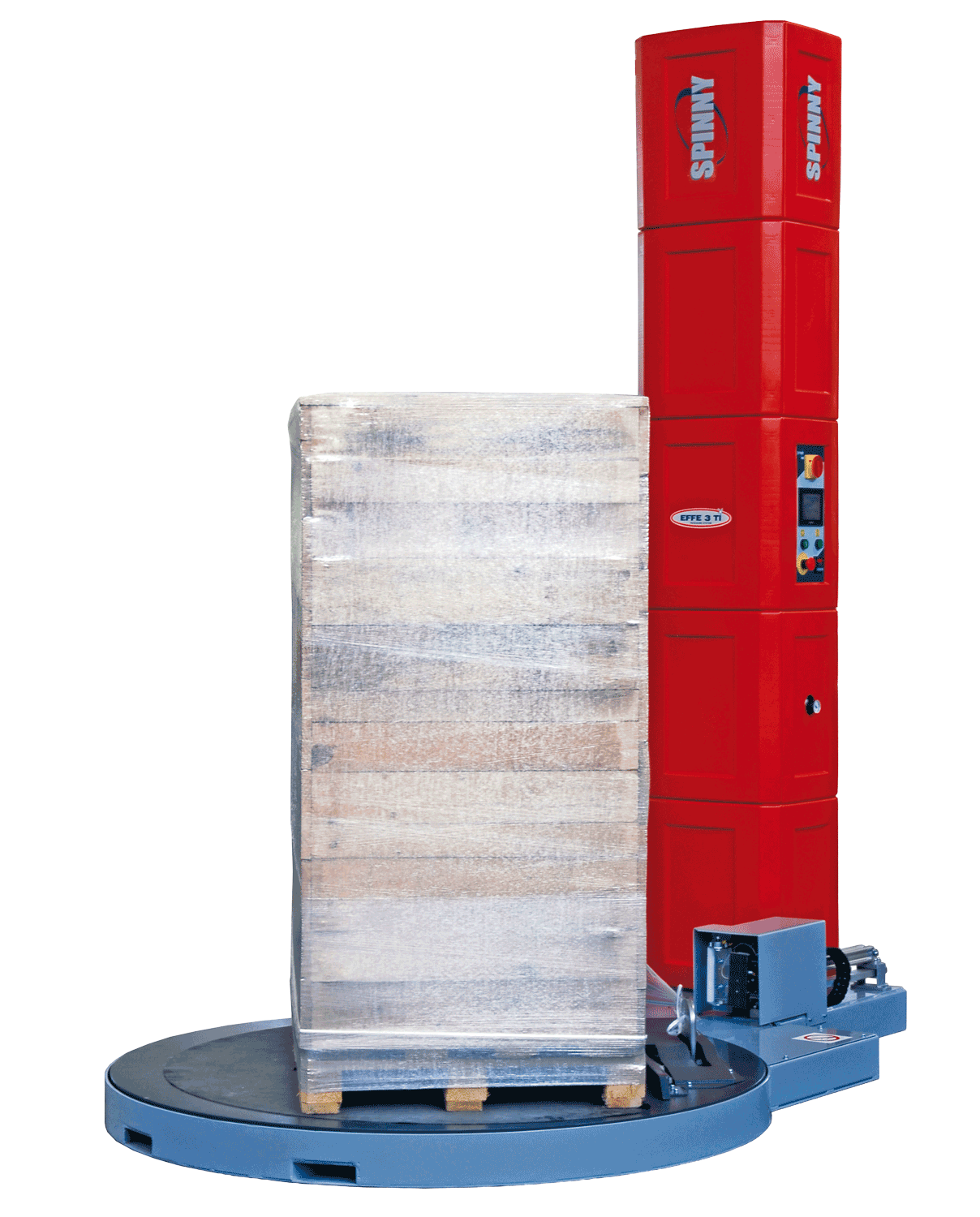
Rotating table pallet wrappers are among the most popular solutions in manufacturing and logistics environments. In this case, the pallet rotates on a platform, while the film carriage moves up and down the column. This proven, versatile technology is suitable for most standard applications, making it highly popular.
This type of wrapping machine is ideal when loads are stable, well-balanced, and compatible with rotation. In other words, when they are not at risk of wobbling while being wrapped.
The main advantages of turntable pallet wrappers are:
- the small footprint;
- ease of use;
- ease of integration in all those contexts where the flow of pallets is regular
Spinny S570 Datalogger.2
The Spinny S570 Datalogger.2 It is a perfect example of how turntable wrapping machines have evolved.
It is a semi-automatic machine equipped with an advanced control system with integrated datalogger (optional), designed for those who want to monitor and optimize the winding parameters; therefore, ideal in contexts of Industry 4.0.
The rotary table ensures uniform wrapping, while the motorized film carriage ensures precise tension control. Thanks to process data management, the Spinny S570 Datalogger.2 is ideal for production environments that focus on consistent quality and traceability, including Industry 4.0.
Spinny S550 Touch
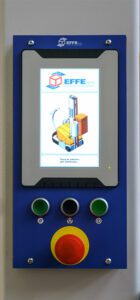
There Spinny S550 Touch Instead, it's a turntable pallet wrapper designed for those seeking operational simplicity and reliability. The touch-screen control panel makes setting wrapping cycles intuitive, allowing the machine to quickly adapt to different pallet sizes. It's a more suitable solution, for example, for warehouses and production departments that handle standard loads and want to improve packaging quality without introducing excessive process complexity.
Rotating arm pallet wrappers: the perfect choice for unstable and heavy loads.
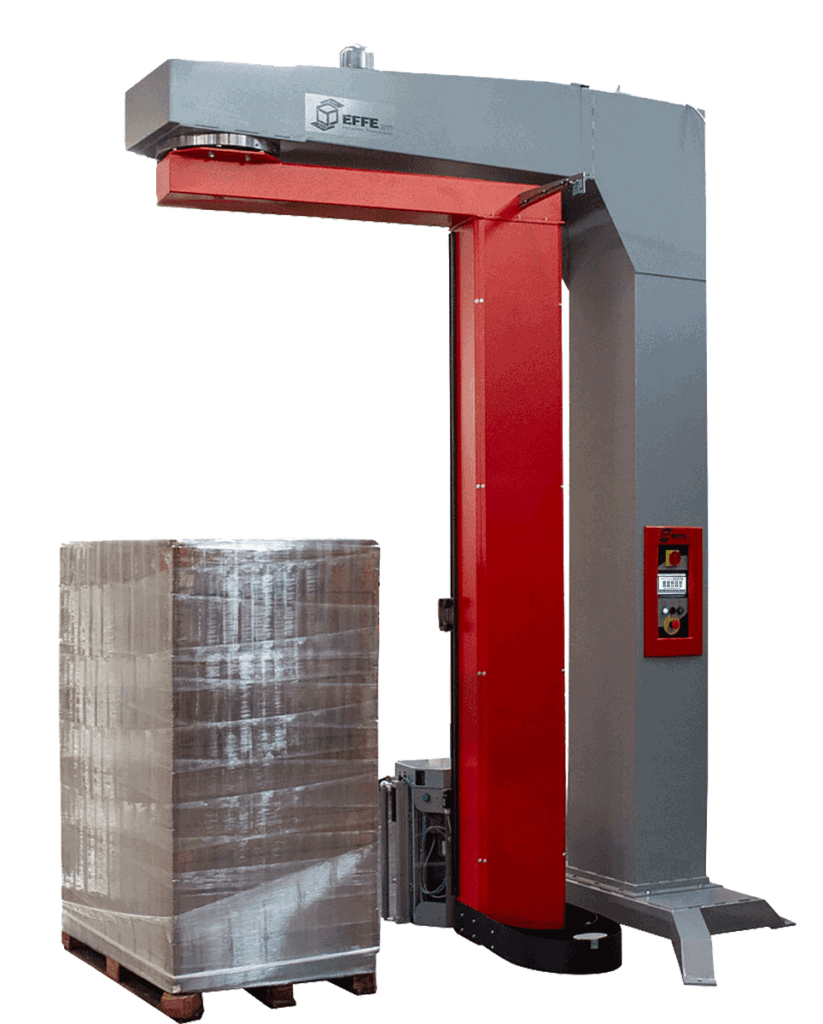
Rotating arm pallet wrappers adopt the opposite approach to rotating table wrappers: in this case, the pallet remains stationary on the ground, while the arm rotates around the load. This configuration eliminates the stresses caused by pallet rotation and is particularly suitable for unstable, very heavy, or large loads.
This type of pallet wrapping machine is often chosen in more structured industrial settings, where load safety and operational continuity are priorities. The pallet is neither lifted nor rotated, reducing the risk of it falling or deforming during wrapping.
Rotax S3370 Datalogger.2
An example of this category is the Rotax S3370 Datalogger.2, a semi-automatic rotating arm pallet wrapper designed for advanced industrial applications.
The control system with optional datalogger allows for the collection and analysis of wrapping data, ensuring repeatability and consistent quality over time. The rotation of the arm allows for the wrapping of unstable or heavy pallets without mechanical stress, making this machine ideal for sectors such as paper processing, building materials, and industrial logistics.
Rotax S3350 Touch
There Rotax S3350 Touch Instead, it is a rotating arm solution designed for those who need high operational flexibility.
The touch panel simplifies the management of wrapping programs and allows the machine to quickly adapt to different loads. It is ideal for production environments where pallets vary in size and weight and where wrapping must be performed safely, keeping the load stable throughout the entire cycle.
Pallet Wrapping Machines: How to Choose Between a Rotating Table and a Rotating Arm
Therefore, the choice between turntable or rotary arm pallet wrappers depends mainly on the type of load and the operating context.
When is a turntable pallet wrapper better?
Rotating tables are ideal for stable pallets, regular flows, and limited space. They offer an excellent balance between cost, simplicity, and efficiency.
When is a rotary arm pallet wrapper better?
Rotating arm wrapping machines, on the other hand, become the preferred solution when loads are unstable, heavy, or difficult to handle, or when you want to minimize risk during wrapping.
In any case, you can rely on Effe3Ti
Rotating table and rotating arm pallet wrappers respond to different but complementary logics. They are not mutually exclusive.
Understanding the differences between the two technologies allows you to make a more informed choice, one that's better suited to your production environment and daily operations. This can improve packaging quality, increase safety, and make the end-of-line process more efficient.
With solutions such as the Spinny and Rotax lines, Effe3Ti offers a range of machines capable of adapting to different production contexts and supports companies towards increasingly reliable and controlled packaging.