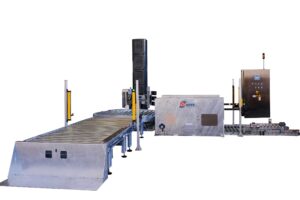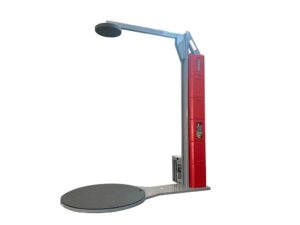
Wrapping robots are the new frontier in pallet wrapping. For years, this activity was considered a "sideline" step: a necessary step between production and shipping, often handled manually or with stationary machines positioned anywhere.
Today the situation has changed.
In companies where you race against time, where space is scarce and loads are not always standard, relying only on traditional lines can mean losing minutes, meters and margins.
This is where wrapping robots come into play: mobile machines that move toward the pallet, not the other way around, allowing for precise wrapping wherever needed, without redesigning spaces or requiring operators to move loads. Therefore, they're not just an additional, autonomous support system, but also capable of non-traditional movements.
For logistics, 3PL, manufacturing, and large-scale retail trade, this isn't just a technological whim: it's a shift in operating model, transforming the end-of-line process from a bottleneck to a measurable efficiency asset.
When are wrapping robots needed?
Wrapping robots are not designed to replace “one machine with another”: they are born to solve those cases in which the winding machines Traditional systems fail to keep pace with the realities of the warehouse. They're the answer to changing configurations, unstable pallets, tight spaces, shifting flows throughout the day, and departments that work independently without a fixed line.
They prove crucial when it is necessary to wrap the pallet where it is located, without returning it to a dedicated station, or when the volumes do not justify an in-line system but the quality of the packaging cannot be compromised.
In all these scenarios, the robot's mobility avoids wasted time, reduces the physical effort of operators, and stabilizes the quality level of packaging.
Some real-world application examples:
- logistics with pallets leaving from different areas of the same site;
- companies with oversized products that cannot rotate on the table;
- decentralized departments where taking a pallet to the machine is slower than taking the machine to the pallet;
- subcontractors and 3PLs who need to adapt to different customers without redesigning the layout;
- reduced shifts or staff shortages where “infrastructure-free” automation is needed.
Each company has its own wrapping robot
The Oscar Touch family represents Effe3Ti's line of wrapping robots designed to bring automation where fixed machines cannot reach.
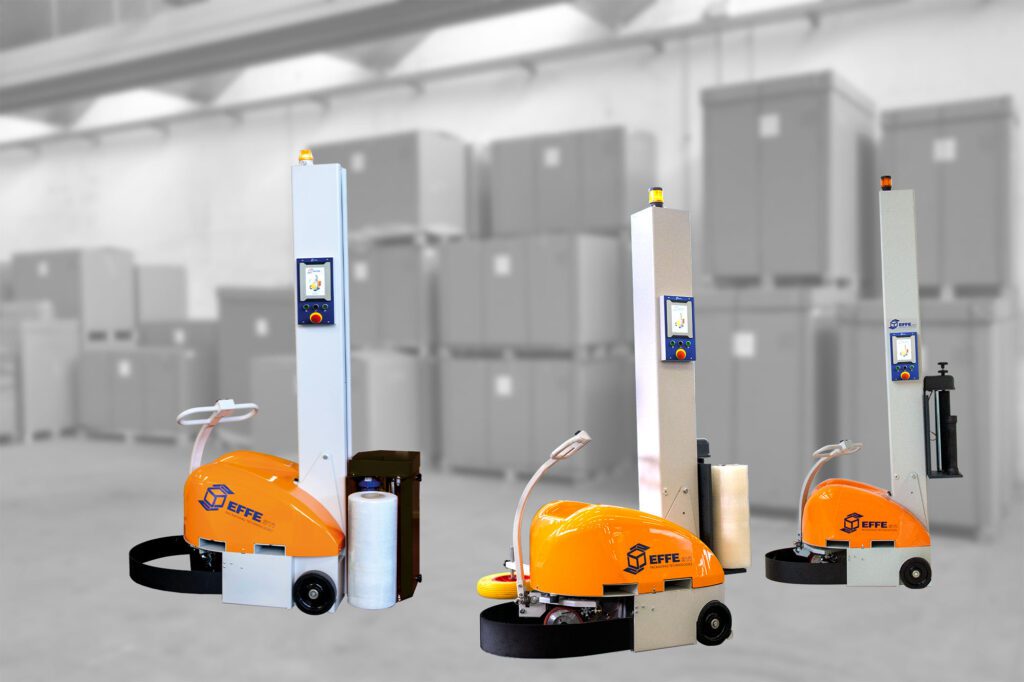
All models move around the pallet, are equipped with a touch panel and detection sensors, and allow for programmable cycles with precise control of film tension and reinforcement phases. Furthermore, the V1, V3, and V5 versions track film end, film breakage, and battery charge status, and the V.5 model is equipped with the 200% motorized pre-stretch (100%, 150%, and even 250% available upon request).
Among the most popular options is the laser scanner for obstacle detection that slows down the movement speed or stops the robot.
Oscar Touch Lithium
The version Oscar Touch Lithium It is available for all Oscar Touch models: V.1, V.3 and V.5.
It is designed to have a clear area of approximately 1,000 mm from the pallet during the wrapping cycle. It can handle more than 350 pallets per charge (based on dimensions of 800 x 1,200 x 1,500 mm), and a full recharge time of approximately 3 hours. It also features a touch panel, patented traction, speed adjustment up to 1.33 m/s, a reel carriage with a speed of 3-5 m/min, and a reinforcement cycle, programmable at any point on the pallet.
Furthermore, it is equipped with a high-performance lithium battery instead of two traditional batteries.
Oscar Touch V.1
The Oscar Touch V.1 offers a robotic solution with mechanical brake for film tensioning. In this case too, the dimensions are 690 x 1,060 x 2,100 mm, with autonomy per charge of up to 250 pallets (intended as 800 x 1,200 x 1,500 mm). The standard charging cycle is approximately 8 hours.
Includes intuitive controls, flashing and audible signalling at start and end of the cycle, wrapping height up to approximately 2,100-2,200 mm (options up to 2,600 or 3,100 mm), feed speed up to 1.33 m/s with soft start/stop, 3-5 m/min carriage adjustment, separate top and bottom reinforcements and adjustable film tension.
Oscar Touch V.3
The Oscar Touch V.3 This is the intermediate version, featuring an electromagnetic brake for film tension. Its dimensions and configuration are similar to the V.1, with a footprint of 690 x 1,060 x 2,100 mm and a minimum pallet of 600 x 600 mm.
In this case, too, the autonomy per load is indicated at around 250 pallets and the machine load is approximately 250 kg. The cycle includes signals, photocell control of the pallet height, movement speed up to 1.33 m/s and film carrier adjustment 3-5 m/min. Options for 2,600-3,100 mm columns are available.
Oscar Touch V.5
The model Oscar Touch V.5 is finally the latest evolution of wrapping robots. It is equipped with motorized pre-stretching 200% (100%, 150% and 250% on request).
Its battery life allows it to handle up to 250 pallets measuring 800 x 1,200 x 1,500 mm. And after eight hours of charging, it's ready to go again.
The machine weighs approximately 250 kg at full capacity, and the column is foldable for easy forklift transport. This makes it ideal for dynamic logistics environments, small spaces, or production lines that require speed and precision. This machine also features an integrated touchscreen control panel.
Wrapping robots are changing the end-of-line
Pallet wrapping has always been a critical point between production and shipping: if done manually, it means wasted time, while a fixed machine means rigidity in the space configuration.
The wrapping robots in Effe3Ti's Oscar range solve both limitations: they take the machine where it's needed, when it's needed, with repeatable cycles and controlled costs.
For companies that need to handle real, not theoretical, volumes and can't afford to stop the flow to adapt to the machines, these robots aren't simply an alternative: they're the modern form of industrial packaging. And for those working with heavy, unstable products or in non-ideal spaces, they're often the only solution that avoids errors, waste, and wasted time.