Automatic strapping machines shouldn't be considered a mere end-of-line detail. Indeed, today they are one of the key factors in measuring the true efficiency of a production plant. In factories, where production rates are increasing and margins are shrinking, even strapping ceases to be an incidental operation, becoming a critical step that can slow down or accelerate the entire workflow. And therefore, it also impacts operating times, costs, margins, and other essential aspects of business management.
For many industrial companies, the question isn't whether to automate; rather, when and how to do it without creating new rigidities. Integrating an automatic strapping machine means rethinking the way products are transported to shipping, reducing manual intervention and operational risks.
Automatic strapping machines and industrial automation
Integrate the automatic strapping machines In industrial processes, this means eliminating bottlenecks and making the end-of-line process consistent with the production rate. Unlike manual strapping machines Whether semi-automatic or automatic, an automatic strapping machine works continuously, with repeatable cycles and constant parameters, reducing operator dependence and the risk of error.
In high-speed production lines, manual strapping quickly becomes a limitation (and a significant one): it slows down the flow, introduces variability – where standardization and uniformity are desired – and increases the risk of downtime.
Automatic strapping machines, on the other hand, synchronize with the belts, roller conveyors, and all handling systems, ensuring a smooth transition from packaging to shipping.
When does online integration make sense?
Naturally, integrating an automatic strapping machine is particularly advantageous when production volumes are high or constant. In sectors such as logistics, food, beverage, or industrial manufacturing, the presence of regular and repetitive loads makes automation a natural choice.
Product standardization also plays a key role.
When package dimensions are uniform, automatic strapping machines can operate at full capacity, applying one or more straps to the same point and with the same tension. This improves load stability and reduces problems during handling or transportation, enabling a truly productive and, importantly, efficient and effective workflow.
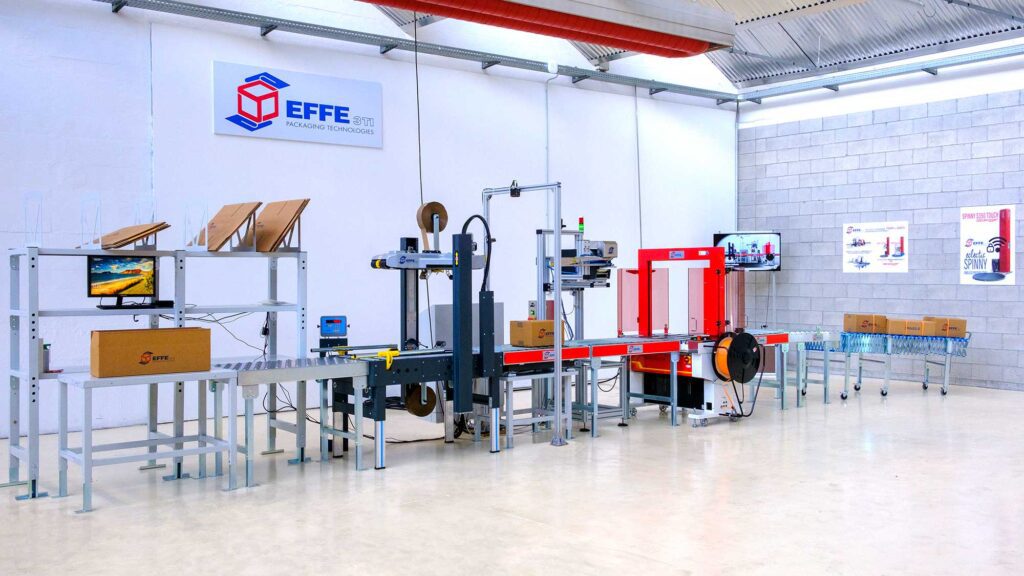
It's also important to consider that in modern end-of-line operations, the automatic strapping machine never operates alone. It's integrated with wrapping machines, weighing systems, labeling systems, and quality control. This way, strapping becomes part of a continuous, monitorable process, where each phase is optimized to reduce downtime and waste.
The most advanced automatic strapping machines can be installed in-line, adapting to the existing layout without disrupting the department's organization. This flexibility is essential for companies that want to gradually automate, without interrupting production. But automatic systems are also worth mentioning, capable of performing multiple operations in succession to deliver a package ready for shipment, such as Line 6×1, which can also be part of an Industry 4.0 project.
Effe3Ti's automatic strapping machines
Automatic strapping machines are a strategic choice for companies seeking reliability, continuity, and control during the packaging process. Effe3Ti solutions address these specific needs: automatic strapping machines designed to operate steadily over time, adapt to complex loads, and meet the needs of various industrial sectors.
TP-702YM: Automatic strapping machine for industrial environments
There TP-702YM It is an automatic strapping machine with a lateral head made of stainless steel, designed to work in production lines where robustness and continuity are fundamental requirements.
The side-mounted strapping head allows it to be used in dusty environments, such as sawmills or brick factories. A wide range of available bows makes it ideal for a wide variety of applications. It is also available pre-painted.
The machine uses PP strapping (5, 6, 9, or 12 mm) and can perform up to 60 ties per minute. It features a control panel with an LCD screen to display messages and machine status, and an ergonomic strap dispenser. An internal heating device also prevents moisture buildup.
TP-601YPT: Automatic strapping machine for non-standard loads
There TP-601YPT It's a lateral strapping machine with an extra-large arch, designed to meet a specific but increasingly common need: strapping large and heavy packages, from household appliances to various palletized products. It can be integrated with most production lines.
It uses PP or PET strapping (from 9 to 15 mm), with tension up to 150 kg, adjustable via the potentiometer on the control panel. It performs up to 11 ties per minute, and in the event of errors or jams, the machine automatically re-launches the strap and prepares for a new cycle.
From machinery to the most robust process
Integrating automatic strapping machines into industrial production processes doesn't just mean increasing end-of-line speed. It also means making production more stable and safe, reducing variability and improving overall packaging quality.
Nowadays, when every second counts and every mistake has a cost, automatic strapping ceases to be a technical detail and becomes a strategic choice for optimizing time, costs, and operations.