Industrial compactors are often evaluated based on two immediate benefits: reducing the volume of waste and reducing the space required to store it. This is true, but this only tells part of their impact. In a warehouse, distribution center, or manufacturing plant, waste is also part of internal logistics, as it must be collected, moved, temporarily stored, and then transported to the collection point.
Every empty box moved, every bag of film transported to the other side of the warehouse, and every pallet filled with waste generates activity that doesn't directly generate value. And the more volumes increase, the more this parallel flow risks interfering with the main flow of goods.
For this reason, the benefits of a baler or compactor aren't measured solely in cubic meters saved: a properly chosen and positioned machine can transform the way people, forklifts, and materials move within a company. And it's precisely by observing these indirect effects that the hidden benefits of industrial compactors emerge.
Here are the six main benefits of adopting industrial compactors.
1. Industrial compactors reduce internal logistics that are often not measured
The first benefit concerns all those movements that are not normally accounted for:
- an empty package must be taken away from the point where it is generated;
- If the material accumulates in a remote area, an operator must collect and transport it. When the container is full, it must be moved again;
- If the waste is very large, these operations may be repeated several times during the shift.
The problem is that, in addition to the time required for these operations, each movement occupies aisles, uses trolleys or other means and potentially interferes with the movement of goods.
Installing industrial compactors near waste generation points shortens this route. The material is compacted before it begins to take up large volumes and can only be transferred to the collection area once it has reached a more manageable size.
An interesting example is AutoLoadBaler, a machine that uses dedicated trolleys to collect cardboard during daily operation; the trolley is then transported to the baler and loaded mechanically. This reduces the need for manual emptying of the container, lifting the material, or breaking the boxes before feeding them into the machine.
2. With industrial compactors the value of space changes
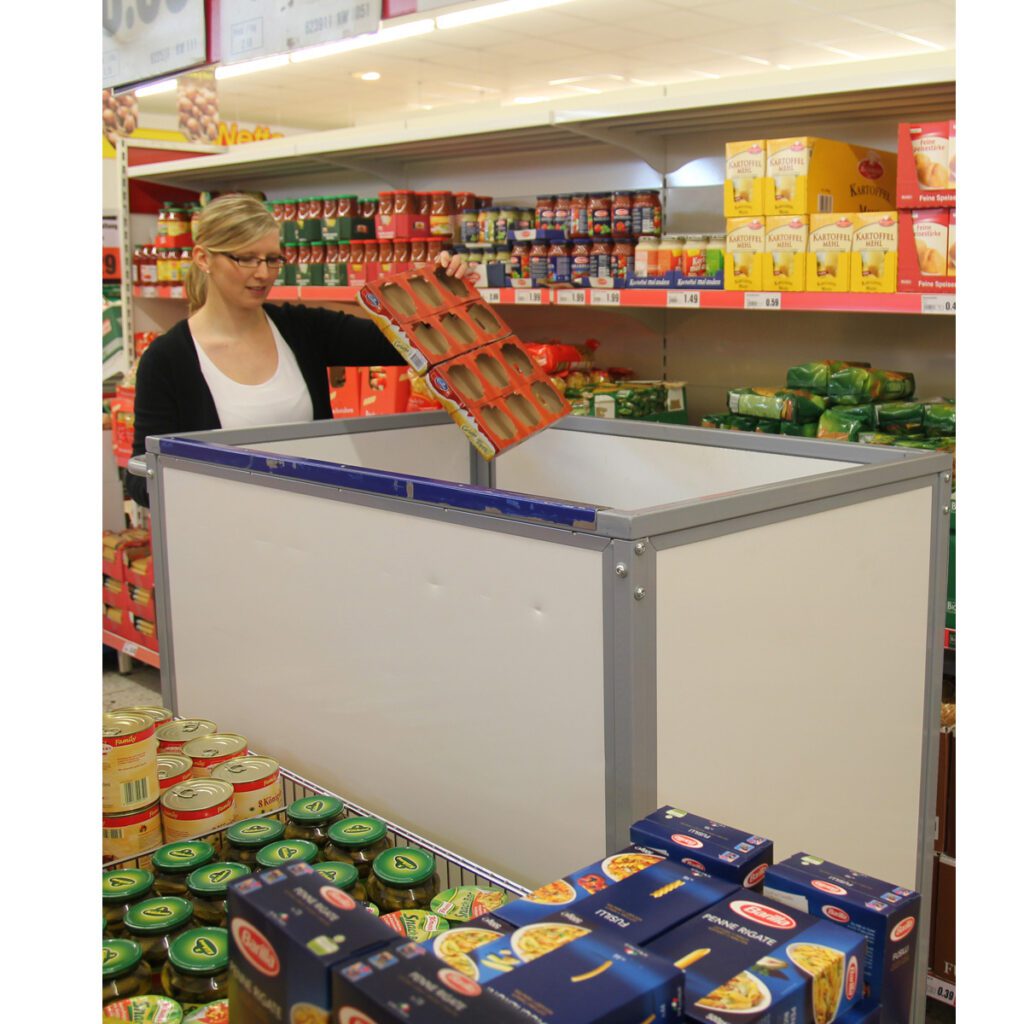
It's true to say that a compactor "frees up space," but the more interesting point is understanding exactly what space it frees up. In a logistics operation, a square meter near the docks, racks, or production lines isn't as valuable as a square meter in a peripheral area of the plant. If cartons, film, or other packaging occupy the operational areas, they're taking away space from value-generating activities.
Compaction therefore allows us to think not only about the quantity of space recovered, but also about its quality.
A vertical press like BP28, for example, can be used in contexts where volumes are large but don't necessarily require a large-scale automated solution. This baler develops a pressing force of 280 kN and can produce bales of up to approximately 320 kg, transforming large quantities of loose material into much more easily storable units.
For a warehouse, this could mean reclaiming an area previously used to store empty boxes and using it for pallets, picking, order preparation, or simply for more orderly circulation.
3. Industrial compactors can reduce internal traffic
The more bulk material needs to be moved, the more routes are needed within the facility. This leads to a third, less obvious benefit of industrial compactors: they can help reduce internal traffic.
This issue is particularly important in large warehouses. Forklifts, pallet trucks, pedestrian operators, and goods often share the same spaces; adding to these flows the constant transfer of cardboard, plastic, or other waste materials increases the complexity.
Compaction reduces the number of units that need to be moved. Instead of repeatedly moving light, bulky material, fewer, denser, and more regular bales are moved. This effect is evident with machines designed for large flows, such as JumboLoadBaler. The baler can handle paper and cardboard, film, empty PET bottles, cans, and octabins. The large loading opening measures 2250 x 1085 x 1700 mm, and the pre-compression system allows for approximately two 400 kg bales per hour.
An important feature, from an internal logistics perspective, is the ability to adapt loading to the operational context: if the material can be transferred to the press following a route consistent with the layout, the need to continuously organize intermediate transport to temporary accumulation areas is reduced.
4. Industrial compactors make operators' work more predictable
One of the most difficult inefficiencies to identify is fragmented work. One worker stops what they're doing because a cardboard bin is full, while another has to clear an area where packaging is piling up. Or, another example, someone has to manually break boxes to fit them into the bin. Each of these tasks takes just a few minutes, but spread out over weeks and months, they can consume significant hours.
Industrial compactors allow you to transform many of these occasional tasks into an organized process.
5. With industrial compactors, collections also become more programmable
Waste doesn't just affect what happens inside the warehouse. It also determines when the pickup truck arrives. Uncompacted material quickly reaches the volumetric limit of bins and collection areas, even when its actual weight remains relatively low. The result can be a pickup frequency determined more by the air being transported than by the actual quantity of material. Industrial compactors alter this relationship.
The JumboLoadBaler, for example, can reduce the volume of waste up to 90% and transform it into bales weighing approximately 400 kg. A regular bale makes it much easier to know how much material has been accumulated and how much space will be needed for transport.
The impact on internal logistics is less immediate, but still significant. If pickups can be scheduled more precisely, the need to create buffer areas to manage sudden material backlogs is reduced.
6. Industrial compactors can improve waste quality
Another less-considered benefit concerns what happens to the material after it leaves the company. Properly separated, compacted, and easily handled waste is different from a jumbled collection of mixed materials. The quality of the outgoing stream can influence the ease with which it is recycled and, in some cases, its value as a recoverable material.
From this perspective, industrial compactors not only serve to reduce waste, but can help transform it into a more organized secondary logistics flow.
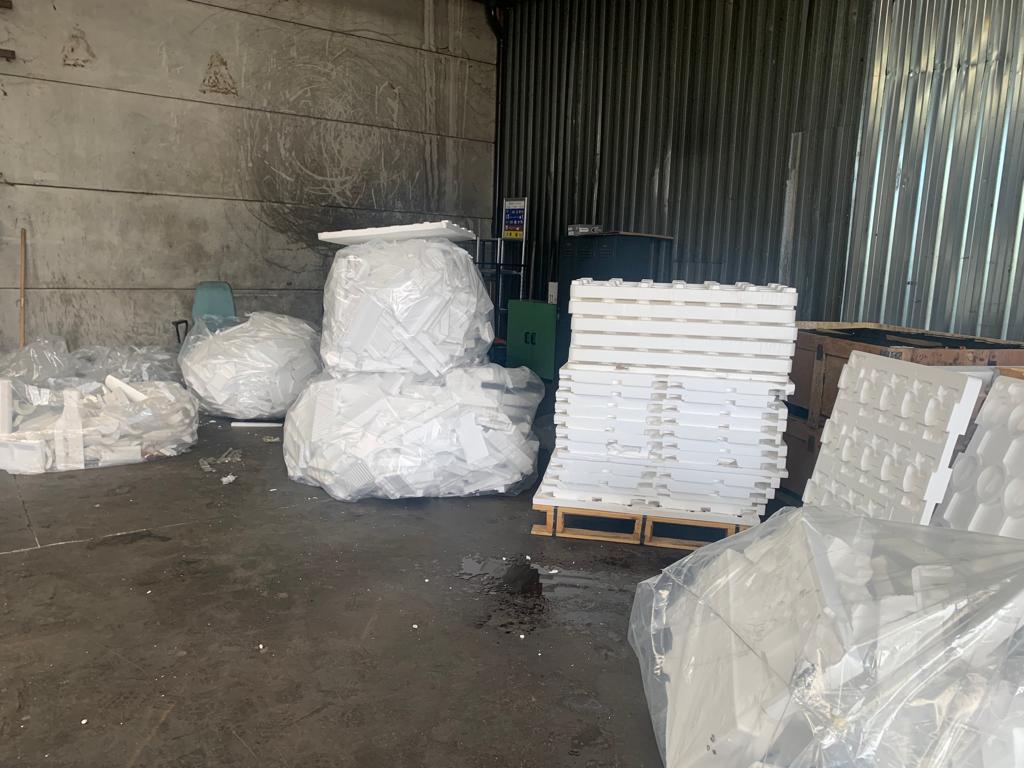
A particularly clear example is expanded polystyrene. EPS is lightweight and takes up a lot of space: transporting it without treatment means moving mostly air.
Styropress addresses this very problem. The polystyrene is shredded and then cold-compacted into briquettes, resulting in a volume reduction of up to 97%. The resulting material is more stable, easier to stack, and can be recycled.
The consequence is interesting: the material that previously represented mainly a logistical cost becomes much easier to store, move and valorize.
Industrial compactors and internal logistics: beyond volume reduction
Industrial compactors produce their most obvious benefits when the bale takes up significantly less space than the original material. But limiting the assessment to this result ignores much of the impact on the company.
Less waste means fewer internal trips. More regular bales mean easier storage. A baler positioned in the right place can free up workspace, reduce interference between flows, and reduce repetitive manual tasks. Compacted material can be transported more efficiently and, in some cases, become more easily exploitable, even generating revenue. Connected machines can also provide previously uncollected information.
This is why a compactor's return on investment shouldn't be calculated simply by asking how much it saves on waste collection. Rather, the question is: how much does it cost the entire organization today to move a piece of waste from the moment it's created until it leaves the company?
It's within this process that the hidden benefits of compaction emerge. And they're often the ones that have the greatest impact on the warehouse's day-to-day efficiency.