Even in 2026, semi-automatic wrapping machines will remain one of the most important solutions for companies that need to manage pallet wrapping without necessarily moving to a fully automated line. Because the market is increasingly focused on logistics costs, load stability, and material consumption, these machines will continue to occupy a central position at the end of the line.
Many companies don't need to automate every step of the process, but they still need to overcome the limitations of manual wrapping. A semi-automatic machine allows you to standardize the application of stretch film, reduce waste, improve pallet safety, and keep the initial investment low.
Semi-automatic and end-of-line wrapping machines: why they are still relevant
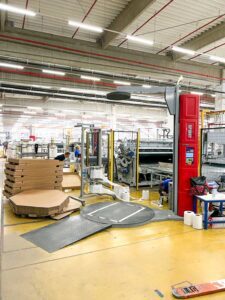
Semi-automatic wrapping machines make pallet packing more efficient without disrupting department organization. Unlike fully automatic lines, they don't always require complex integration with conveyors, handling systems, or existing equipment. They can be more easily integrated into warehouses, production areas, and logistics departments where work isn't continuous but still requires quality and repeatability.
And even in 2026, this feature remains crucial. Many companies work with variable volumes, seasonal peaks, different pallet formats, and spaces not always designed for full automation. In these cases, a semi-automatic machine allows for process improvements without sacrificing flexibility.
The operator still plays a role in managing the cycle, but no longer has to manually perform the entire wrapping process. This reduces fatigue, improves consistency, and results in more stable pallets, especially when loads undergo internal handling, storage, or transportation.
Semi-automatic wrapping machines to reduce stretch film consumption
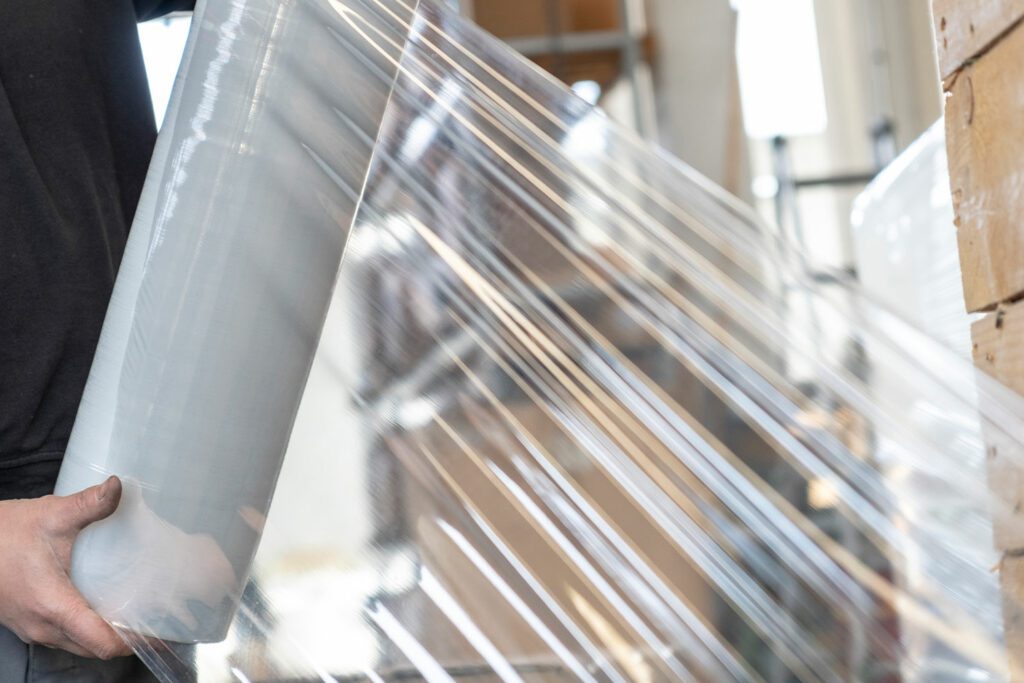
One of the main advantages of semi-automatic wrapping machines is the control of the stretch film. Manual wrapping often tends to be uneven: in some areas, the film may be too tight, in others too loose. The result is unpredictable consumption and load stability that depends heavily on the operator's experience.
Semi-automatic machines, on the other hand, allow for more precise settings. Rotation speed, tensioning, reinforcement turns, and carriage movement can be adjusted based on the type of pallet. In more advanced models, motorized pre-stretch allows the film to be stretched before application, using less material without compromising the packaging's stability.
This aspect directly impacts costs. Stretch film is a recurring consumable: even a partial reduction, if applied to hundreds or thousands of pallets over the course of a year, can generate significant savings. At the same time, using less film means reducing the environmental impact of packaging, an increasingly important issue in corporate policies.
Semi-automatic rotating table wrapping machines: the Spinny range
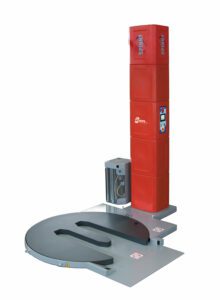
Among the most popular solutions are the semi-automatic rotating table wrapping machines. In these machines, the pallet is placed on a rotating platform, while the reel-holding trolley applies the film along the height of the load. This configuration is suitable for stable and even pallets, and is widely used in warehouses, production departments, and companies with medium-low or medium throughput.
In the Effe3Ti catalogue, the Spinny range represents one of the most interesting examples. Spinny S140 It is designed for small and medium-sized companies that want to eliminate manual wrapping and improve load stability. It is available in a Plus version, with a mechanical brake, and an Advanced version, with an electromagnetic brake. The rotary table can hold up to 2,000 kg, and the rotation speed is adjustable via inverter, allowing the cycle to be adapted to the characteristics of the pallet.
At a higher level is the Spinny S300, equipped with motorized pre-stretch. This system reduces film consumption and improves packaging seal, making the machine suitable for companies with larger volumes or requiring greater control over the material used. The ability to manage work programs and customized parameters also allows for a more consistent process, even when multiple operators use the same machine.
There Spinny S370 Datalogger.2 Instead, it integrates semi-automatic wrapping machines into a more advanced monitoring and control framework. It's a solution designed for those who want to combine the flexibility of semi-automatic machines with work data collection, useful for analyzing production, consumption, and performance. For companies that are digitizing their end-of-line processes, this type of solution allows them to maintain a reasonable investment without sacrificing more advanced management tools.
Semi-automatic rotating arm wrapping machines for complex loads
Semi-automatic wrapping machines are not limited to rotary table models. When the pallet is unstable, heavy, irregular, or difficult to rotate, a rotating arm solution may be more suitable. In this case, the load remains stationary on the ground, while the machine's arm rotates around the pallet, applying the film.
This principle is particularly useful when table rotation could compromise the stability of the load. This occurs with lightweight and unevenly stacked goods, very tall products, heavy pallets, or packaging that cannot tolerate lateral stress. Keeping the pallet stationary reduces the risk of shifting and allows for more controlled wrapping.
An example is the Rotax S3300, semi-automatic rotating arm wrapping machine equipped with motorized pre-stretch. This machine is suitable for applications requiring stability, film control, and increased safety for complex loads. The arm speed is adjustable, while integrated safety systems protect the operator during the work cycle.
For many companies, switching from a rotary table to a rotary arm depends not only on production volume, but above all on the type of load. If the pallet cannot be rotated safely, a rotary arm machine becomes a more sensible choice.
The role of sustainability in packaging
Semi-automatic wrapping machines also contribute to making industrial packaging more sustainable. Sustainability, in this case, depends not only on the material used, but also on how it is used. Poorly applied film can require multiple turns, more material, and more corrective actions. Film applied with the correct tension and pre-stretch, on the other hand, protects the load while using fewer resources.
Reducing stretch film consumption has both an economic and environmental impact. Less material purchased, less plastic used, and less waste to manage. For companies that need to account for their environmental policies or improve process efficiency, pallet wrapping also becomes an area worth addressing.
When are semi-automatic wrapping machines the right choice?
Semi-automatic wrapping machines are the right choice when manual wrapping is no longer sufficient, but full automation is not yet necessary or is not compatible with the company's layout. They are suitable for businesses handling medium volumes, pallets that are not always identical, operating spaces that need to be preserved, and departments where the presence of an operator remains essential.
The choice of model depends on several factors. For stable and even pallets, a rotary table from the Spinny range can offer a good balance between simplicity and performance. For more delicate or unstable loads, a rotating arm solution like the Rotax S3300 can ensure greater safety. For companies that want to monitor data and consumption, models equipped with digital systems can become a more consistent investment as the end-of-line process evolves.
The key is to evaluate not only the number of pallets to be wrapped, but also the type of goods, load stability, film consumption, cycle frequency, and the company's growth objectives.
With a semi-automatic wrapping machine you have more control
Semi-automatic wrapping machines remain key in 2026 because they address a still widespread need: improving the end-of-line process without making it unnecessarily complex. They offer more control than manual wrapping, require a lower investment than automatic lines, and allow for adjustments to packaging costs, safety, and quality.
From the Spinny S140 to the Spinny S350, the Spinny S570 Datalogger.2, and the Rotax S3300, the Effe3Ti catalog demonstrates how broad and diverse the world of semi-automatic solutions is. These aren't "passive" machines, but rather tools that remain central to many companies: they're flexible, upgradeable, and capable of supporting the growth of logistics and production processes.