Cardboard compactors can be vertical or automatic, but the choice between the two depends on more than just the volume of waste produced. For example, it also depends on the way the cardboard is generated, the frequency with which it must be handled, the available space, and the level of automation already in place within the company.
In practice, this means that in a small warehouse, for example, a vertical baler can offer everything needed to reduce space and better organize waste. In a large logistics or distribution facility, however, the flow can be so continuous that an automatic machine, capable of receiving material with less operator intervention, is more cost-effective.
The difference, therefore, isn't simply between a "small" and a "large" solution: vertical and automatic correspond to two different ways of organizing cardboard handling. Understanding which of the two is best suited to the process is the first step to avoiding both an undersized machine and an excessive investment.
Vertical cardboard compactor: how it works and when it's best
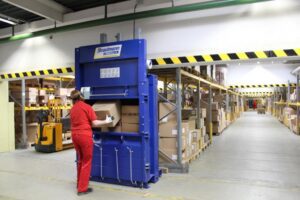
The vertical cardboard compactor is one of the most popular solutions for all those companies that generate medium-low or medium-high quantities of packaging without having a completely continuous flow.
Operation is relatively simple. The operator inserts the material into the loading chamber, starts the cycle, and a plate compresses the cardboard vertically. This operation is repeated until the required amount is reached to form the bale, which is then tied and ejected.
One of the main advantages is its compactness. A vertical baler can be installed close to the area where packaging is produced or disposed of, reducing material movement within the plant. Management is also relatively simple, as there's no need to design a full-fledged automatic feeding system.
All this makes the vertical cardboard compactor the ideal solution for large shops, manufacturing companies, warehouses, laboratories, and logistics centers with flows that are not high enough to justify an automatic system.
The limitation becomes especially apparent as the quantity of cardboard increases. Each cycle requires a certain level of human intervention. If operators have to feed the baler almost continuously, the time spent managing waste can begin to impact productivity.
Automatic cardboard compactor: when volume changes the process
An automatic cardboard compactor starts from a different logic and is designed for all those situations in which waste is not produced occasionally, but enters into a true continuous flow.
In these cases, the problem is not only to compress the material, but also to:
- prevent boxes and packaging from piling up;
- reduce manual interventions;
- ensure that the machine can keep up with the pace of logistics or production.
Automatic systems can be powered by different solutions and, depending on the machine, integrate automated bale compaction, formation, and possibly tying processes.
The advantage becomes evident when considering working hours: reducing the number of manual operations means freeing staff from a repetitive task and making waste management more continuous.
But volume is not the only criterion for choosing
The quantity of material to be handled is naturally one of the first factors to consider when choosing a cardboard compactor. Yet, limiting oneself to this can lead to an incomplete assessment. In other words, two companies may produce the same amount of cardboard throughout the day, but do so in very different ways: one may generate it progressively over eight hours of operation; the other may concentrate it in a few moments, for example during unloading operations.
Therefore, the response to each requirement is also different. In the first case, it may be important to have a system that continuously absorbs the material. In the second, a sufficiently sized vertical press can easily handle peaks.
It's therefore important to consider the frequency and concentration of flows, in addition to the overall quantity. The time operators can dedicate to loading the machine also becomes an economic factor. If several hours a day are spent simply moving, inserting, and compressing boxes, automation can begin to generate a measurable return, independent of the pure volume of waste, but only by increasing workflow efficiency and reducing downtime.
Vertical cardboard compactor: BP28 as reference Effe3Ti
An example of a vertical cardboard compactor present in the catalogue Effe3Ti is the BP28, a vertical chamber press designed for companies that need to handle significant quantities of material without necessarily requiring an automated process.
The BP28 develops a pressing force of 280 kN, equivalent to approximately 28 tons, and completes the cycle in approximately 48 seconds. The loading hopper measures 1190 x 555 mm, while the bales can weigh approximately 320 kg, with dimensions of 1200 x 800 x 800 mm. In addition to paper and cardboard, the machine can also process plastic film, PET, and cans.
The operator maintains control over loading and can operate the press according to the department's actual production rhythms. Therefore, the BP28 is suitable for companies that produce large but variable volumes, where installing an automatic system could introduce more complexity than is actually necessary.
Automatic cardboard compactor: BaleTainer for large flows
On the automatic side, a reference in the catalog Effe3Ti is BaleTainer, designed to handle large quantities of materials such as paper, cardboard, film and PET.
The baler develops a force of 600 kN and can produce bales weighing up to approximately 400 kg. One of its distinctive features is automatic twine tying: once the material reaches the desired condition, the bale is prepared without requiring the same manual operations typical of a vertical baler.
Feeding can also be manual or automated, allowing the machine to be adapted to the layout and volume of material produced. BaleTainer reduces volumes up to the 90% and allows for continuous operation.
When to switch from vertical to automatic?
There's no universal threshold beyond which a vertical cardboard compactor should be replaced with an automatic one. However, there are some fairly clear operational signals:
- The first is the frequent accumulation of uncompacted cardboard. If the baler can't keep up with the pace of material production, it means the system's actual capacity is becoming insufficient;
- The second concerns personnel. When operators spend a significant portion of their shift loading and operating the press, automation is worth considering;
- A third signal is company growth. A warehouse that progressively increases the number of orders, a distribution chain that expands flows, or an expanding production department can reach a point where continuing with manual management becomes increasingly less cost-effective.
The need for continuity also matters. If boxes arrive constantly and can't be piled up waiting for an operator, automation becomes an integral part of the department's organization.
Cardboard compactor: choosing the machine starting from the process
Choosing a vertical or automatic cardboard compactor means deciding how you want to organize your waste management. A vertical solution like the BP28 is ideal when compaction power is needed but flow can still be managed through operator intervention. An automatic machine like the BaleTainer, on the other hand, becomes more attractive when volume and continuity require compaction to become a stable process, less dependent on manual operations.
It is not correct, therefore, to automatically consider the largest or most automated press as the best one. On the contrary, an oversized machine It can generate unnecessary costs and complexity. A solution that's too small can also slow down the process.
A broad, cross-sectional assessment must be made: material produced, work peaks, available space, labor costs, bale weight, and growth prospects must all be considered together. It is from this analysis, rather than from individual technical features, that the most efficient solution for the company emerges.