Rotating arm stretch wrappers address a particularly pressing end-of-line issue: securing heavy, irregular, oversized, or unstable pallets without subjecting them to rotation during stretch film application. When the load is tall, light, out of shape, or consists of products that can shift easily, the wrapping phase can also become critical.
In the turntable wrapping machines The pallet rotates as the film is applied; in rotating-arm wrappers, however, the load remains stationary and the machine arm rotates around it. This limits stress on the product and allows for pallets that would otherwise be difficult or unsafe to rotate.
For logistics, manufacturing companies, and production departments that handle particularly heavy or unstable goods, this feature makes the difference between a simple wrapping cycle and a process truly suited to the characteristics of the load.
How swing arm winders work
The operating principle of rotating arm wrappers is relatively simple: once the pallet is positioned in the work area, the load is no longer moved. The arm, equipped with a reel-holding trolley, rotates around the goods while the film is distributed along its entire height.
This configuration eliminates the need to rotate the pallet on a platform. This is a clear advantage when the load has uneven weight distribution or when it consists of products that could shift under rotation.
Consider, for example, very light boxes stacked on multiple levels, bags, products with uneven bases, or particularly tall goods. With a rotary table, acceleration and deceleration must be carefully managed to avoid compromising stability. With the rotating arm, this problem is eliminated at its source: the pallet remains in the same position throughout the entire cycle.
They are suitable for heavy and non-standard loads
In rotary table machines, the pallet must be supported and rotated by the platform, which necessarily has a certain load capacity. In rotating arm systems, the weight remains on the ground or on the line's conveyor system.
This makes the technology particularly useful for very heavy pallets and, more generally, for products that are difficult to handle. Building materials, industrial production, large packages, and non-standard loads are some of the situations in which keeping the product stationary can significantly simplify wrapping.
The principle also applies to size. When using solutions specifically designed for large formats, avoiding rotating a bulky product allows for greater control over the cycle and easier adaptation of the technology to the industrial layout.
Why swing arm wrappers improve stability
Final stability depends not only on the pallet remaining stationary. Rotating arm wrappers also allow precise control over the film application: the speed of the arm, the vertical movement of the carriage, the number of rotations at the top and bottom of the pallet, and even the film tension can all be adjusted according to the product's characteristics.
This allows for a specific cycle to be designed for the load to be protected, further increasing the safety of the operation and the guarantee of the final result. A lightweight pallet may require different parameters than a very heavy one; a tall, loosely packed product may require reinforcement in certain areas; an irregular load may require a different distribution of the film along its height.
Furthermore, in systems equipped with motorized pre-stretch, the film is stretched before application. In addition to reducing material consumption, this solution allows for better control of the tension on the product. In certain applications, it is also possible to use rope-type film tensioning systems, concentrating the film's resistance in specific areas of the pallet to improve the anchoring of the goods.
Effe3Ti Rotating Arm Winders: Rotax S3300
Among the rotating arm winders present in the Effe3Ti catalogue, the Rotax S3300 It is a semi-automatic solution designed specifically to combine load stability, performance and control in the use of stretch film.
The standard model can handle pallets up to 1200 x 1200 mm without any capacity limitations related to pallet rotation. The standard wrapping height is 2100 mm, detected by a photocell, while configurations for greater heights are available upon request. The arm rotation speed can be adjusted via an inverter between 4 and 15 rpm. The movement of the reel holder trolley is also customizable, allowing the cycle to be adapted to the type of goods.
The Rotax S3300 features a motorized pre-stretch system. The electronic panel allows you to manage ten password-protected wrapping cycles and program the reinforcement wraps at the top and bottom of the pallet separately.
For particularly delicate applications, it is also possible to integrate a motorized or pneumatic stabilizing press, useful for maintaining greater control of the load during the cycle.
Rotax S3350: Performance and film control for rotary arm wrappers
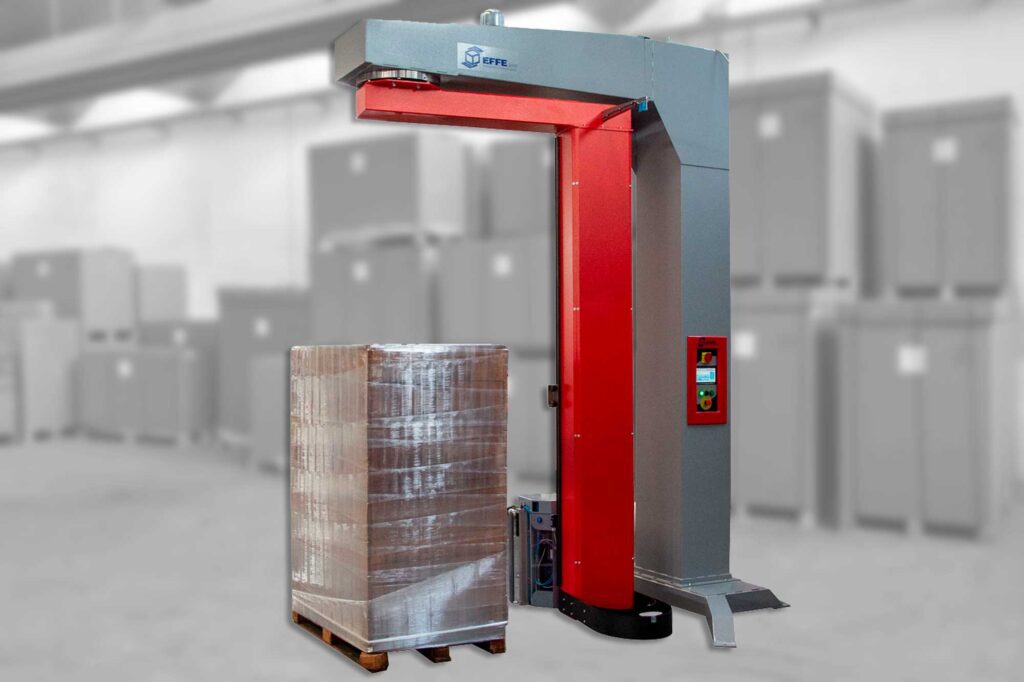
Another solution in the range is the Rotax S3350, semi-automatic rotating arm wrapping machine that pays particular attention to film management and cycle programmability.
The machine uses a motorized pre-stretch system capable of reaching 300%. In practical terms, one meter of film can become four meters of material applied to the pallet. In the Dual Motor configuration, pre-stretch can reach up to 400%, further increasing the possibilities for material optimization.
The Rotax S3350 features a touch-screen control panel and ten password-protected programs. It can be configured for different wrapping heights, up to 3600 mm in the standard configurations, making it ideal for companies handling particularly tall pallets.
Rotating Arm Wrappers and Industry 4.0: Rotax S3370 Datalogger.2
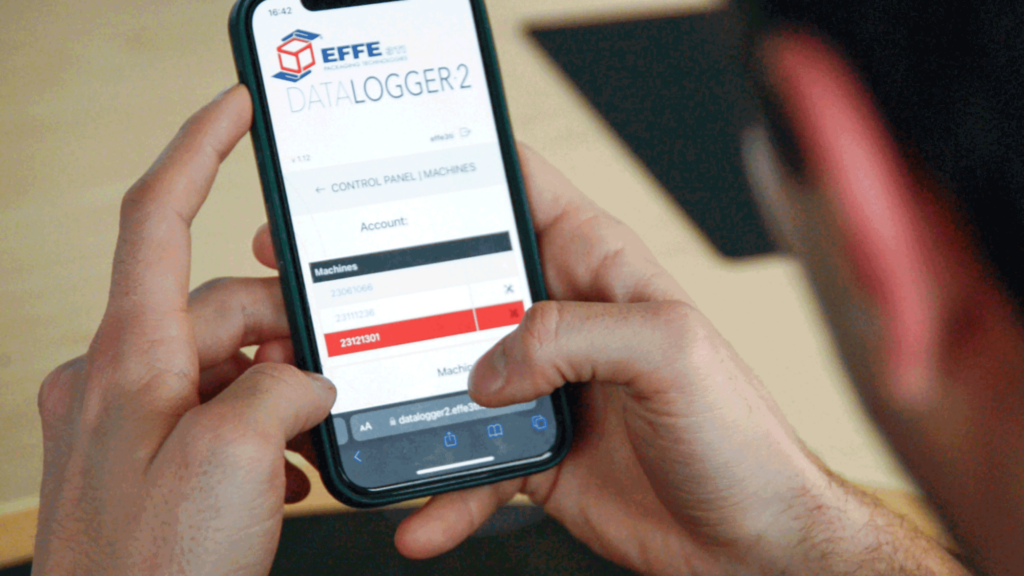
Rotating arm winders can also be included in end-of-line digitalisation processes. Rotax S3370 Datalogger.2 This is the most representative example within the Effe3Ti range. It is a semi-automatic solution that maintains the operating principle of the Rotax family—a stationary pallet and a rotating arm—combined with tools for collecting and analyzing wrapping data.
In a structured industrial environment, this allows us to address another aspect of stability: process repeatability. Knowing which parameters were used, controlling cycles, and having information on machine operation helps reduce variability from one pallet to the next.
When to choose rotary arm winders?
Rotating arm wrappers therefore become particularly interesting when the company regularly handles pallets that have characteristics incompatible with easy and safe rotation, such as:
- high weight;
- product instability;
- non-standard dimensions:
- uneven distribution of masses;
- need to keep the goods completely still during the cycle.
The choice must, however, start from the analysis of the process and therefore: number of pallets per hour, film characteristics, load height, available layout, degree of automation and production variability must be considered together.
Rotating arm wrappers: stability starts with the right machine
Rotating arm wrappers address the problem of unstable loads with a precise logic: instead of moving the pallet, they hold the product still and rotate the wrapping system. This simple principle is particularly important with heavy, tall, irregular pallets, or those containing goods that could shift during rotation.
Effe3Ti models such as the Rotax S3300, Rotax S3350 and Rotax S3370 Datalogger.2 show how this technology can adapt to different levels of production complexity, from semi-automatic management to more digitalized processes.
For a company that handles difficult loads, choosing a rotating arm doesn't simply mean changing the type of wrapping machine: it means designing the end-of-line based on the actual characteristics of the product and reducing critical issues right when the pallet is prepared for handling and transport.