Pallet wrappers are among the most common end-of-line solutions for stabilizing and protecting loads before shipping. Behind a seemingly simple function lies a variety of technologies, each designed to meet specific needs. Wrapping robots, turntable wrappers, and rotating arm wrappers work differently and directly impact productivity, safety, and even space management.
The choice, therefore, is less straightforward than it might seem. Understanding the differences between these solutions is essential for choosing the system best suited to your operating context.
When is a robotic pallet wrapper better?
Robotic pallet wrappers are self-propelled machines that move around the pallet, without requiring a fixed location. This approach essentially allows the load to be wrapped directly where it is located, avoiding additional handling.
A very popular example of Effe3Ti is the’Oscar Touch V.1 Pallet wrapping robot, designed to operate on pallets starting from 600 x 600 mm, with autonomy of more than 250 cycles per load and adjustable feed speed up to approximately 1.33 m/s.
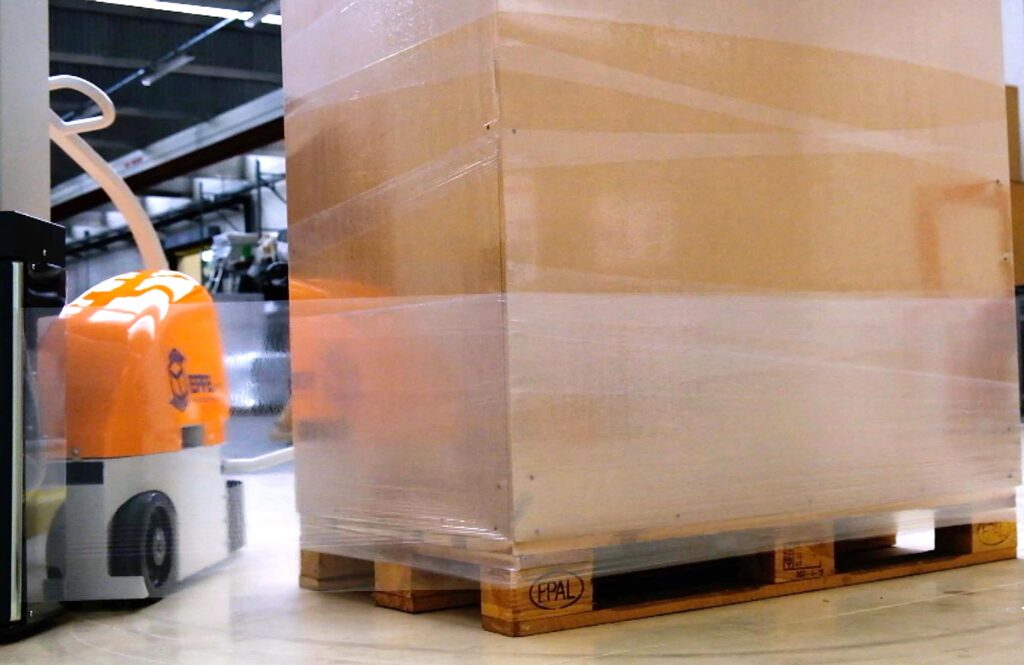
This type of pallet wrapper is particularly suitable for:
- unstable or out-of-gauge loads;
- environments with variable spaces;
- warehouses without a fixed layout.
The possibility of programming customized cycles and adjusting parameters such as speed and film tension makes the robot a very versatile solution. Furthermore, since they do not require fixed installations, wrapping robots allow for space optimization and adapt to non-standardized workflows.
When is a turntable pallet wrapper best?
Rotating table pallet wrappers are among the most widely used in companies. In this case, the pallet rotates on a platform, while the film-holding trolley moves vertically.
A representative model from the Effe3Ti catalogue is the Spinny S500 Touch, semi-automatic machine with motorized pre-stretch up to 300% (up to 400% on request) and automatic film cutting and sealing system at the end of the cycle.
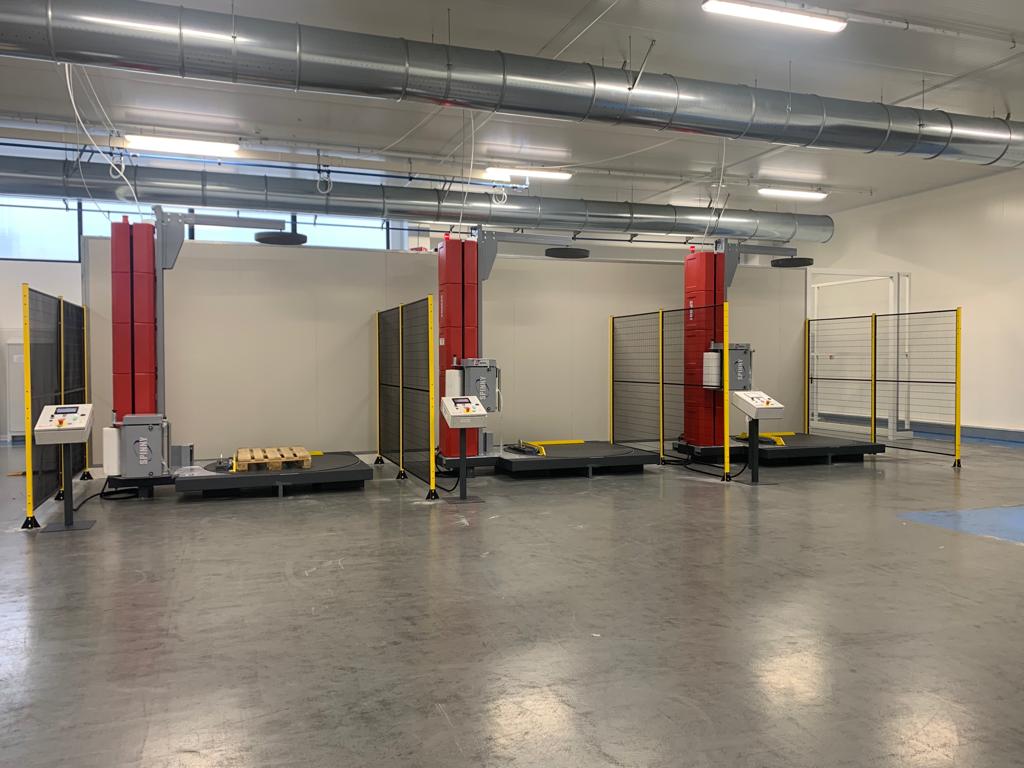
This typology is distinguished by:
- ease of use;
- small footprint;
- relatively affordable costs.
Rotating table wrapping machines are suitable for stable and well-balanced pallets. They offer good productivity and intuitive operation, thanks to programmable control panels and automated cycles.
However, pallet rotation can represent a limitation in the case of fragile, unstable or particularly heavy loads.
When is a rotating arm pallet wrapper better?
And so we come to the third type. Rotating arm pallet wrappers adopt a logic opposite to those with a turntable: the pallet remains stationary; the arm rotates around the load. This system eliminates rotational stress and improves packaging safety.
An example is the Rotax S3350, equipped with motorized pre-stretching up to 400%, touch screen panel and arm speed adjustable via inverter between 4 and 15 rpm.
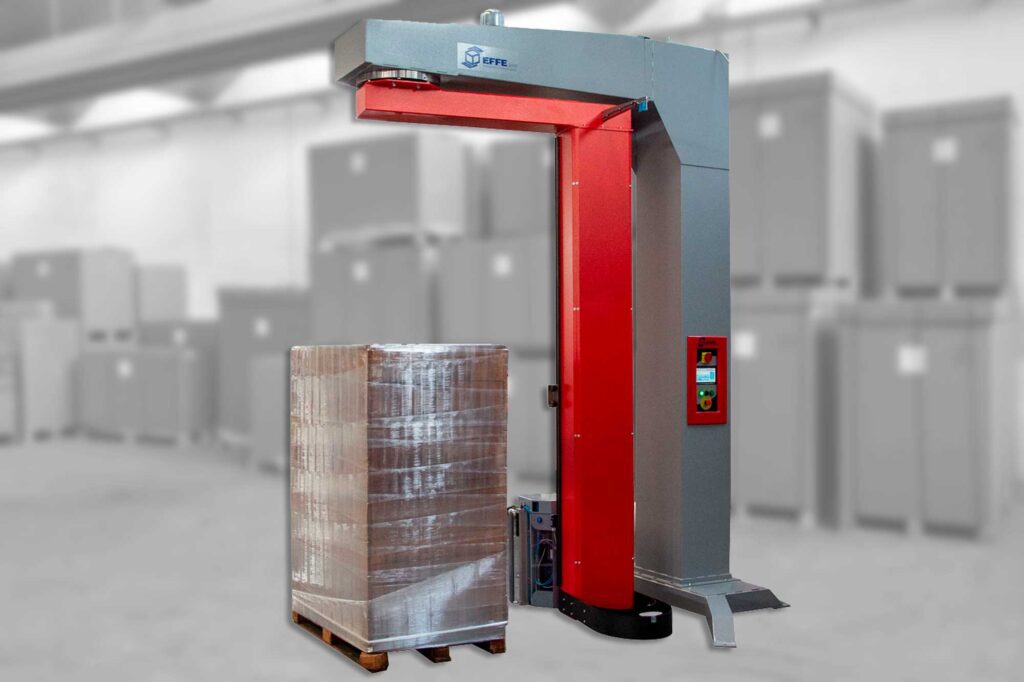
This technology is therefore suitable for:
- unstable or very heavy pallets;
- bulky loads;
- high-intensity production contexts.
Rotating arm wrapping machines guarantee greater productivity than rotating tables and allow you to work on pallets without weight limits, precisely because they are not rotated.
How to choose the most suitable pallet wrapper
The choice between different types of pallet wrappers depends mainly on three factors: the type of load to be wrapped; the workload; and the organization of the space.
And so:
- robots are ideal for dynamic environments and non-standard loads;
- turntable pallet wrappers are a simple solution for stable pallets;
- while rotating arm pallet wrappers, on the contrary, are preferable for heavy or unstable loads.
Each technology has its own application area and allows for the optimization of specific aspects of the packaging process. In fact, it's very likely that a company will need multiple wrappers to accommodate different loads.
An appropriate system, therefore, allows for reduced lead times, improved packaging quality, and a smoother transition from production to shipping. In this sense, robots, rotary tables, and rotating arms are not equivalent alternatives, but rather different tools for solving different problems.